


Once I realised I had hours to explore the handful of pieces on display, I slowed down and looked more closely. I began to notice the detail in the clothing worn by some of the embroidered figures. With low lighting and glass cases limiting how close I could get to the pieces, I had the impression that variegated thread had been used to illustrate itajime shibori fabrics. An example of Itajime shibori:


Image courtesy of Doris Lovadina Lee www.blog.dorislovadinalee.com
Itijame imitated in embroidery:
But really? The indigo itajime was so convincing, how did the embroiderer achieve that?


Image courtesy of Glennis Dolce shiborigirl.wordpress.com
How lucky we are to have access to digital cameras! I was able to take a photo and immediately enlarge the image to see how the itajime effect had been achieved, and it wasn’t variegated thread at all, but two shades overstitched in a way that gave a perfect impression of the shades of colour on fabric that is a hallmark of shibori. Incredible!


Both these figures are from the large collar pictured at the top of this post.
I spent at least an hour examining these embroideries closely to enjoy the minute details so masterfully brought to life by the artisans who created these pieces.


The collar above reminds me of this:


Image courtesy of Upstate via textileartscenter.com

And the lower garment in this one has a similar spaciousness to this yukata’s pattern:


Image courtesy of Stephen Szczepanek srithreads.com


What a beautiful robe! It appears quilted: 


The golden robe with a hexagonal design above has a similar busyness to this eight-fold one:


Image courtesy Bruce Malcolm narablog.com
Notice also the detail in the centre of the red flower as well as in the railing behind her, which appears to me to be bamboo:
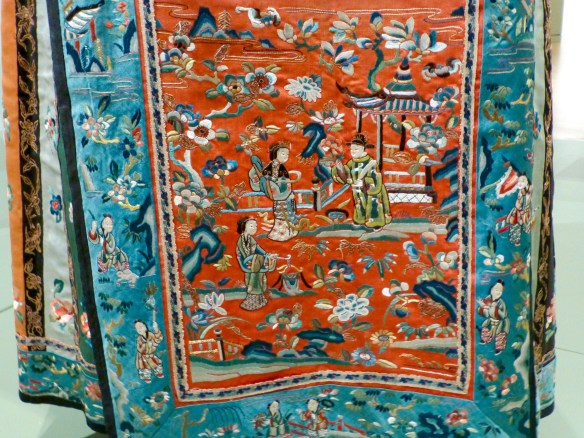
The clothing of these figures from the border of the skirt above are rendered in very fine detail:

Even the fish has scales and a shimmering tail:


From the main panel of the same skirt:


If you would like to learn more about shibori, an excellent book to begin with is Shibori: The Inventive Art of Japanese Shaped Resist Dyeing by Mary Kellogg Rice and Yoshiko Iwamoto Wada:

You may also wish to visit the World Shibori Network
The exhibition at the National Textile Museum at George Washington University, Washington DC continues for another month, and the gallery guide can be viewed here.


See images of a beautiful Bhutanese embroidered depiction of sumptous fabrics at https://textiletrails.com.au/2016/04/12/imitating-textiles-bhutan/